Choosing a route that fits your family
The single biggest mistake families make is picking a route based on what looks impressive on a map rather than what will actually work for their kids. A 2,800-mile cross-country haul sounds great until hour six with a four-year-old.
Start with your youngest child's realistic tolerance for car time, then work backward to pick a route. For families with children under 6, shorter regional loops of 500 to 800 total miles tend to hold together better than transcontinental runs. Older kids with screens and audiobooks can handle more.
Some route frameworks worth considering:
- The Pacific Coast Highway corridor between Los Angeles and San Francisco offers frequent stopping points within short intervals.
- The Blue Ridge Parkway in Virginia and North Carolina has slow speed limits, overlooks every few miles, and minimal commercial traffic.
- A Great Lakes loop through Michigan, Wisconsin, and Indiana packs in beaches, dunes, and small-city stops without requiring flyover-state marathon driving days.
For national park-anchored itineraries, see which national parks work best for family road trips. If you need help gauging whether a specific destination is age-appropriate, this guide on what makes a US destination genuinely kid-friendly gives a useful pre-commitment framework.
Building a realistic budget
Fuel, lodging, and food are the three core categories, and all three are consistently underestimated. Gas calculations that ignore city driving inefficiency and AC load tend to run 15 to 20 percent short. Lodging booked the night of, rather than in advance, often costs 30 to 50 percent more in summer peak season.
A full breakdown of where road trip money actually goes, including the expenses most families miss entirely, is at what a road trip budget actually covers.
~$300
Estimated daily road trip cost for a family of four
General industry estimates suggest a family of four can expect to spend roughly $250 to $350 per day on a US road trip when combining fuel, lodging, and food.
3 in 10
Children who experience motion sickness
Pediatric health guidance commonly cites motion sickness as affecting a significant share of children, particularly between ages 2 and 12.
350 miles
Recommended daily driving limit with kids
Travel planning resources and family travel advisors consistently point to 300 to 350 miles as a manageable daily distance for families with children.
A few practical anchors: budget $0.18 to $0.22 per mile for fuel on a mid-size SUV or minivan (adjust for current prices and your vehicle's real-world highway MPG). Budget $120 to $180 per night for a hotel room that comfortably fits two adults and two children. Budget $60 to $80 per day for food if you are mixing grocery stops with one sit-down meal. These are rough general ranges, not guarantees; your actual costs will vary by region and season.
Keep a running total in a shared notes app so both adults can see spending against budget in real time. This cuts the end-of-trip financial shock that catches many families off guard.
Planning your driving days
Three hundred to 350 miles per day is the range where most families with school-age children arrive at their stop without anyone in tears. Younger children push that ceiling down further.
Structure each driving day around two planned stops rather than pushing through. A mid-morning stop at a state park, rest area with a playground, or small-town main street does more to reset the car's mood than any in-car entertainment. Stopping smart along any US route covers how to find and sequence these breaks effectively.
Departing between 6:00 and 7:00 a.m. gets you through the first 150 miles before kids are fully awake and restless. It also clears major metro areas before midday congestion. Arriving at your lodging by 4:00 p.m. gives children time to decompress before dinner and bedtime, which makes the next morning considerably easier.
Build at least one full non-driving day into every four to five days of travel. Even kids who cope well with car time need a day to run around, swim, or explore without a departure deadline. That buffer also absorbs weather delays and vehicle issues without derailing the whole trip.
Packing the car without the chaos
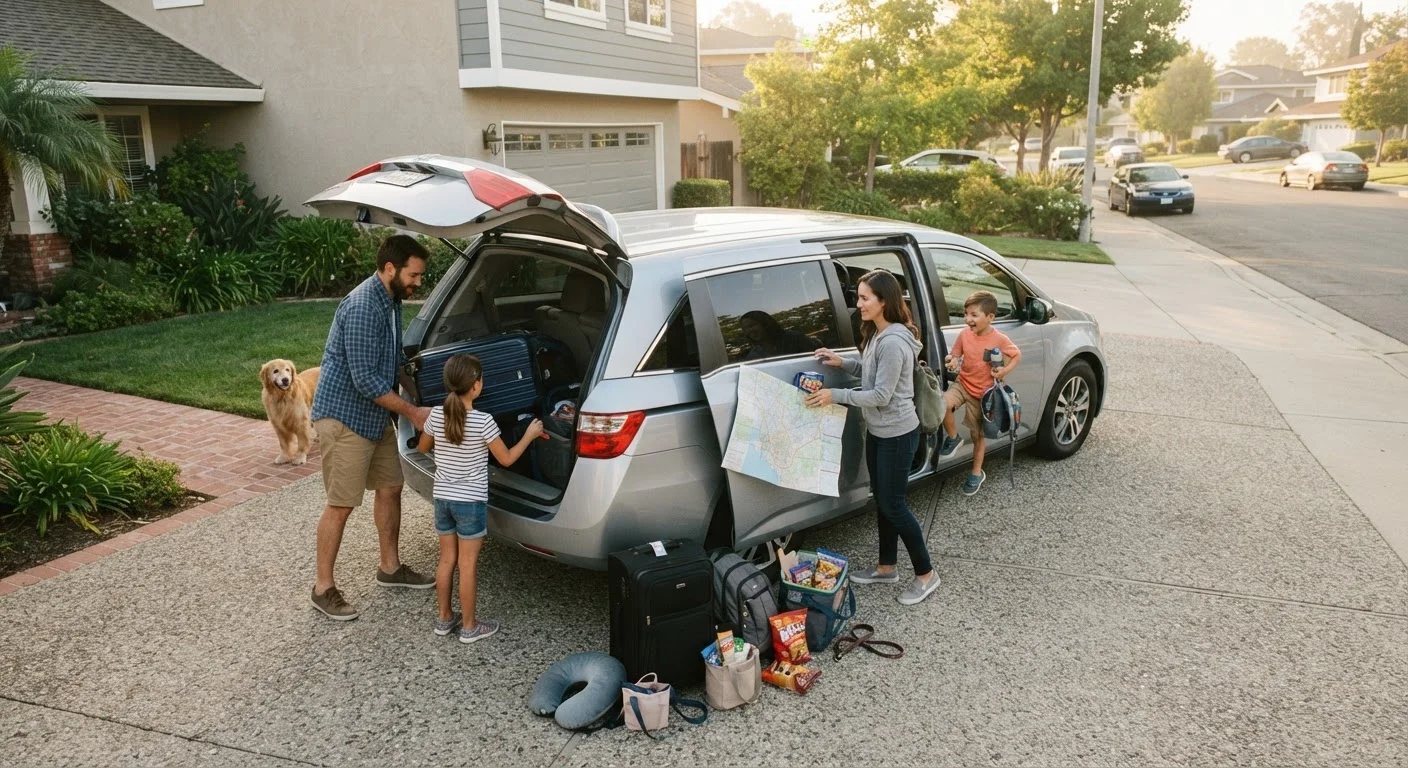
Load order matters. Items needed most often during the drive belong in the easiest-access position: a soft bag in the rear footwell or behind the front passenger seat. Luggage used only at overnight stops goes deepest in the cargo area.
A dedicated snack bin with a lid prevents the foraging that creates mess and distraction. Stock it with items that do not melt, crumble badly, or have strong smells in a closed vehicle. Protein-forward options hold hunger longer than crackers and fruit pouches alone.
Each child over age five benefits from a personal road trip bag they pack themselves, within limits you set. When kids have ownership of their own entertainment and comfort items, adults field fewer requests mid-drive.
For a complete pre-departure packing and vehicle readiness check, see this family travel readiness checklist.
Keep the most-used items at arm's reach
Pack a single soft-sided bag with wipes, snacks, a change of clothes per child, and any medications, and place it where the front passenger can reach it without stopping. Digging through the cargo area on the side of a highway wastes time and creates stress. Anything you might need in the first 30 minutes of driving should never be buried.
Keeping kids comfortable on long drives
Motion sickness is more common than parents expect: around 1 in 3 children experience it to some degree. Seating kids in the middle seat, keeping the car cool, and limiting screen use during curves can reduce symptoms. Over-the-counter options exist; consult your pediatrician before the trip if your child has a history of motion sickness.
Audiobooks and podcasts made for kids hold attention longer than video on most drives because they do not require staring at a screen. Libraries often provide free access to audiobook platforms worth checking before you spend money on a subscription.
Car games with no equipment (license plate game, 20 questions, story rounds) cost nothing and create some of the moments families remember longest. Build a short list before departure so you are not improvising when patience runs low.
For a deeper look at why long drives feel harder than they should, and how planning choices drive that, see why long road trips feel longer than they should.
Pre-departure checklist
The hours before leaving are when avoidable problems get locked in. A written checklist, reviewed the evening before, handles the details that slip through in the excitement of departure morning.
- Tire pressure and tread depth checked (including the spare)
- Oil level, coolant, and windshield washer fluid confirmed
- Car seats inspected and adjusted for any children who have grown since the last trip
- Insurance card and vehicle registration in the glove compartment
- Roadside assistance information saved in both adults' phones
- First aid kit stocked and within reach
- Medications, including any for motion sickness or allergies, packed and accessible
- Snack bin loaded and positioned
- Offline maps downloaded for areas with limited cell service
- Hotel confirmations printed or saved offline
Families planning a hybrid trip that includes a city stop alongside driving days may find this Washington D.C. family vacation guide a useful pairing, since D.C. sits within easy driving range of much of the East Coast and offers a strong anchor destination. For broader deal-finding context across the planning process, family vacation deals resources cover what to look for without locking you into a specific booking path.