Why national parks make sense as a road trip anchor
A national park gives a family road trip a concrete purpose. Instead of driving from hotel to attraction with no throughline, the park becomes the destination everyone can orient around, whether that means a six-year-old collecting Junior Ranger stamps or a teenager doing a half-day hike. The infrastructure is already there: visitor centers, paved scenic drives, ranger-led programs, and campgrounds or gateway towns with lodging at a range of price points.
Before committing to any specific park, it helps to read the terrain honestly. What makes a US destination genuinely kid-friendly breaks down exactly what to assess before you book, including trail difficulty, accessibility for strollers, and the ratio of active time to downtime a destination demands. That framing applies directly to park selection.
The parks below are chosen because they work across a range of ages and physical abilities, have reliable visitor infrastructure, and sit within reach of interstate highway systems that make them practical road trip stops rather than isolated fly-in destinations.
Grand Canyon National Park, Arizona
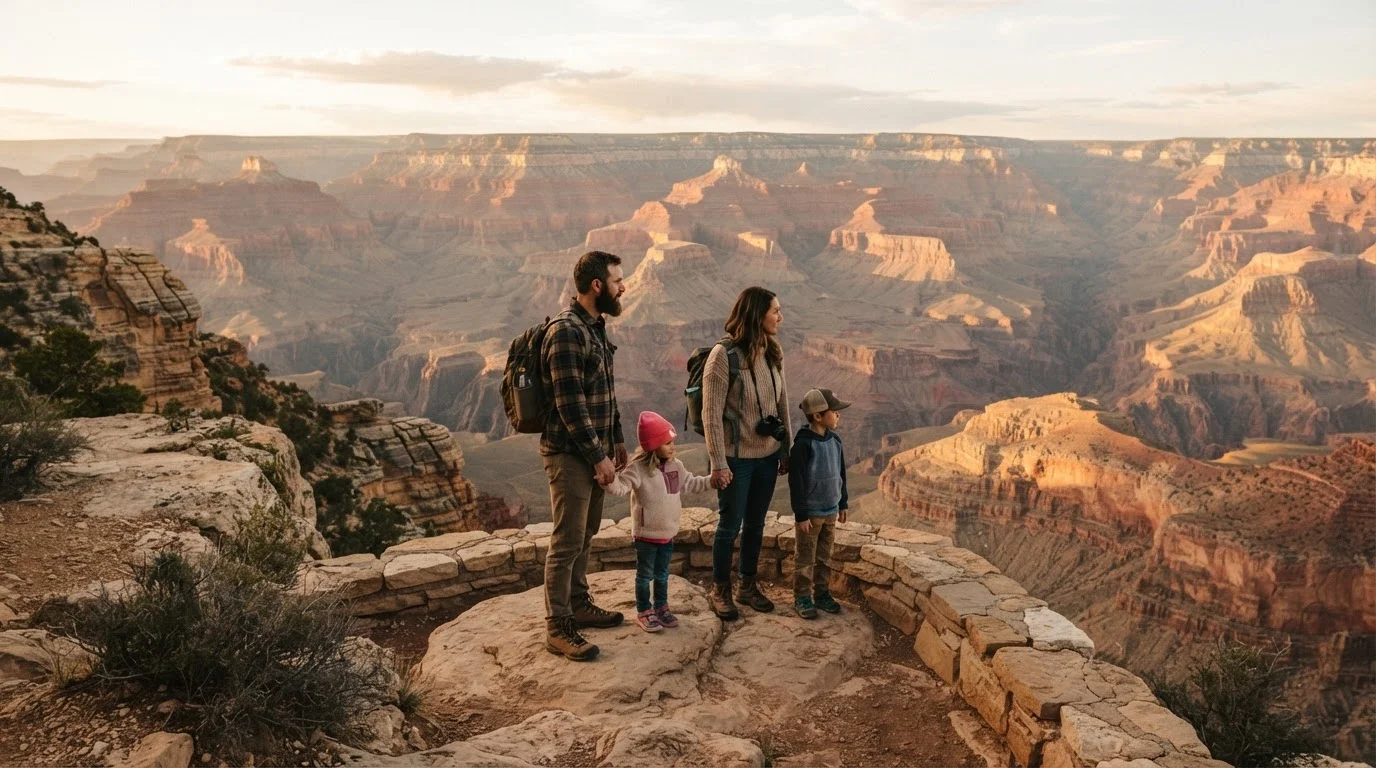
The South Rim is accessible year-round and has paved rim paths that work for strollers and young children who cannot manage steep backcountry trails. The Bright Angel Trail descends from the rim and gives older kids a genuine sense of the canyon's depth without requiring a full descent. Ranger programs run daily at the visitor center, and the park has free shuttle buses that eliminate most in-park driving. Avoid the inner canyon in summer heat; rim temperatures are far more manageable. Nearest major highway access is via I-40 and US-180 from Flagstaff.
The South Rim's paved paths and free shuttles make the Grand Canyon workable even with strollers.
Acadia National Park, Maine
Acadia sits on Mount Desert Island off the Maine coast and is a practical anchor for a New England road trip. The park's carriage roads, built for horse-drawn carriages, are now paved and wide enough for family cycling. Jordan Pond has a flat, accessible loop trail around its perimeter. The free Island Explorer bus system connects most trailheads and reduces parking pressure, which gets severe in July and August. Timed vehicle reservations are required for the summit road to Cadillac Mountain during peak season. Shoulder season in September offers less crowds and the start of fall foliage.
Acadia's carriage roads give families a car-free way to cover serious ground on bikes.
Great Smoky Mountains National Park, Tennessee and North Carolina
The Smokies are the most visited national park in the country, partly because there is no entrance fee. The park straddles the Tennessee-North Carolina border and is within a day's drive for a large portion of the eastern US population. Laurel Falls is a paved 2.6-mile round trip to a waterfall that works for most school-age kids. Cades Cove, a valley with a scenic 11-mile loop road, gives young children reliable wildlife sightings including deer and black bears. Clingmans Dome, the highest point in the park, is accessible by car with a short steep walk to a viewing tower. Crowds are heaviest in October and over summer holidays; mid-week visits help.
No entrance fee and easy access from I-40 make the Smokies a practical anchor for eastern road trips.
Yellowstone National Park, Wyoming, Montana, and Idaho
Yellowstone works for families because the geothermal features, geysers, hot springs, and mud pots, are visible from boardwalks with minimal hiking. Old Faithful erupts on a predictable schedule, giving families a concrete event to plan around. The park's wildlife, including bison herds that regularly cross roads, makes for genuine excitement for kids without any trail effort. The Grand Loop Road connects all major regions and is manageable as a multi-day drive-and-stop trip. Book lodging or campgrounds inside the park many months in advance; gateway towns like West Yellowstone and Gardiner have more availability but add drive time.
Yellowstone's boardwalk geothermal features let toddlers experience the park's most dramatic landscapes.
Olympic National Park, Washington
Olympic covers three distinct ecosystems within one park boundary: temperate rainforest, alpine meadows, and a coastal strip with tidepools. That variety means a four- or five-day visit feels like multiple destinations. The Hoh Rain Forest visitor center has short loop trails through old-growth trees that are manageable for young children and visually unlike anything in the eastern US. Ruby Beach on the coast has sea stacks and tide pools that hold kids' attention for hours. The park has no single entrance point and requires some planning to navigate between ecosystems, but US-101 rings most of the peninsula and makes it accessible as a loop road trip from Seattle.
Three ecosystems in one park boundary gives Olympic unusual value for a multi-day family stay.
Rocky Mountain National Park, Colorado
Trail Ridge Road crosses the Continental Divide and reaches above 12,000 feet without requiring any hiking, putting alpine tundra within reach of families with very young children. Bear Lake, accessible by shuttle, has a flat loop trail and connects to a network of moderate hikes for older kids. Altitude is the main planning variable: families arriving from low elevation should spend a day at lower trailheads before attempting anything above 10,000 feet. The park is reachable from Denver via US-36 in about 90 minutes, which makes it a practical stop on a Colorado road trip that also includes Rocky Mountain towns like Estes Park.
Trail Ridge Road puts alpine scenery within reach of families who cannot manage high-altitude hikes.
Making the most of your park visits
A few logistics decisions have an outsized effect on how smoothly a park visit goes with kids. Timed entry permits, now required at parks including Acadia and Arches during summer, sell out weeks in advance. Check the park's official site well before your departure date. The America the Beautiful Interagency Annual Pass covers entrance fees at all national parks and is worth calculating against your planned stops: a family paying per-vehicle fees at three or four parks will typically recoup the cost of the pass.
Use Junior Ranger programs as a planning tool
Every park in the system has a Junior Ranger program that gives kids a booklet of activities tied to what they will actually see and do in that park. Picking up the booklet at the visitor center within the first hour sets a purpose for the day and reduces the 'I'm bored' friction that derails park visits. Most programs are free, and kids receive a badge or patch when a ranger signs off on their completed booklet. Check each park's website in advance to see whether a booklet can be downloaded and started in the car on the way in.
Pacing is where most family park trips go wrong. Why so many family trips fall flat details the planning missteps that derail vacations, and nearly all of them apply to park visits: overpacked days, skipped rest stops, and underestimating drive times between park gates and trailheads. Build in a half-day buffer for each park rather than scheduling activities wall to wall. For full route and logistics planning, Family road trips across the US: a complete planning guide covers everything from vehicle prep to overnight stop strategy.