Why fuel-saving myths spread so easily
Gas prices are a real pressure for suburban commuters covering 20 or 30 miles a day. That pressure creates an audience for any tip that promises relief, and a market for products that promise even more. The problem is that many of those tips circulate because they sound plausible, not because they have been measured. A few are outright wrong; others produce effects so small they are statistically invisible in a real commute.
Understanding which claims hold up matters because acting on bad information can cost money rather than save it. This article works through the most common myths, compares them against what vehicle engineers and government fuel-economy researchers have documented, and points toward the habits and checks that do make a measurable difference.
For a broader look at the conditions quietly draining your tank, see why your car burns more fuel than it should.
Myth
Fuel additives and "mileage booster" tablets can significantly improve gas mileage.
Fact
Independent testing by the U.S. EPA has found that the overwhelming majority of aftermarket fuel additives do not produce measurable fuel economy improvements.
The U.S. Environmental Protection Agency has evaluated dozens of aftermarket fuel economy devices and additives over the years and has not confirmed significant mileage gains from any of them. Some products contain detergents that may help maintain injector cleanliness over time, but that is a maintenance function, not an efficiency upgrade. Modern gasoline already contains detergent packages required by EPA standards. Spending money on separate additives for a benefit your fuel already provides is not a savings strategy.
Myth
Coasting in neutral saves fuel because the engine is not under load.
Fact
On modern fuel-injected vehicles, coasting in gear with your foot off the accelerator cuts fuel delivery to near zero. Shifting to neutral actually restores a small idle fuel flow.
Fuel injection systems on vehicles made in the past few decades use a feature called deceleration fuel cut-off: when you lift off the throttle while in gear, the engine management system stops injecting fuel almost entirely. The drivetrain's connection to the wheels keeps the engine spinning. Shift to neutral and the engine must idle under its own power, which requires a small but continuous fuel supply. Beyond the fuel question, coasting in neutral removes engine braking as a tool, which can increase the demand on your friction brakes and reduce control in descents or sudden stops.
Myth
Premium gasoline improves fuel economy and engine performance in any car.
Fact
Premium fuel only benefits engines specifically designed or calibrated for higher octane. In a standard engine, it burns no more efficiently than regular.
Octane rating measures a fuel's resistance to premature ignition (knock), not its energy content. Engines with high compression ratios or turbochargers are engineered to take advantage of that knock resistance, and some will genuinely perform better on premium. If your owner's manual says "regular recommended," premium provides no gain and costs more per gallon. If it says "premium required," using regular can cause knock that the engine management system compensates for by retarding ignition timing, which reduces power and efficiency. Check your manual rather than assuming either direction. Premium vs. regular gasoline covers the octane question in full detail.
Myth
Inflating tires to the maximum pressure shown on the sidewall improves fuel economy.
Fact
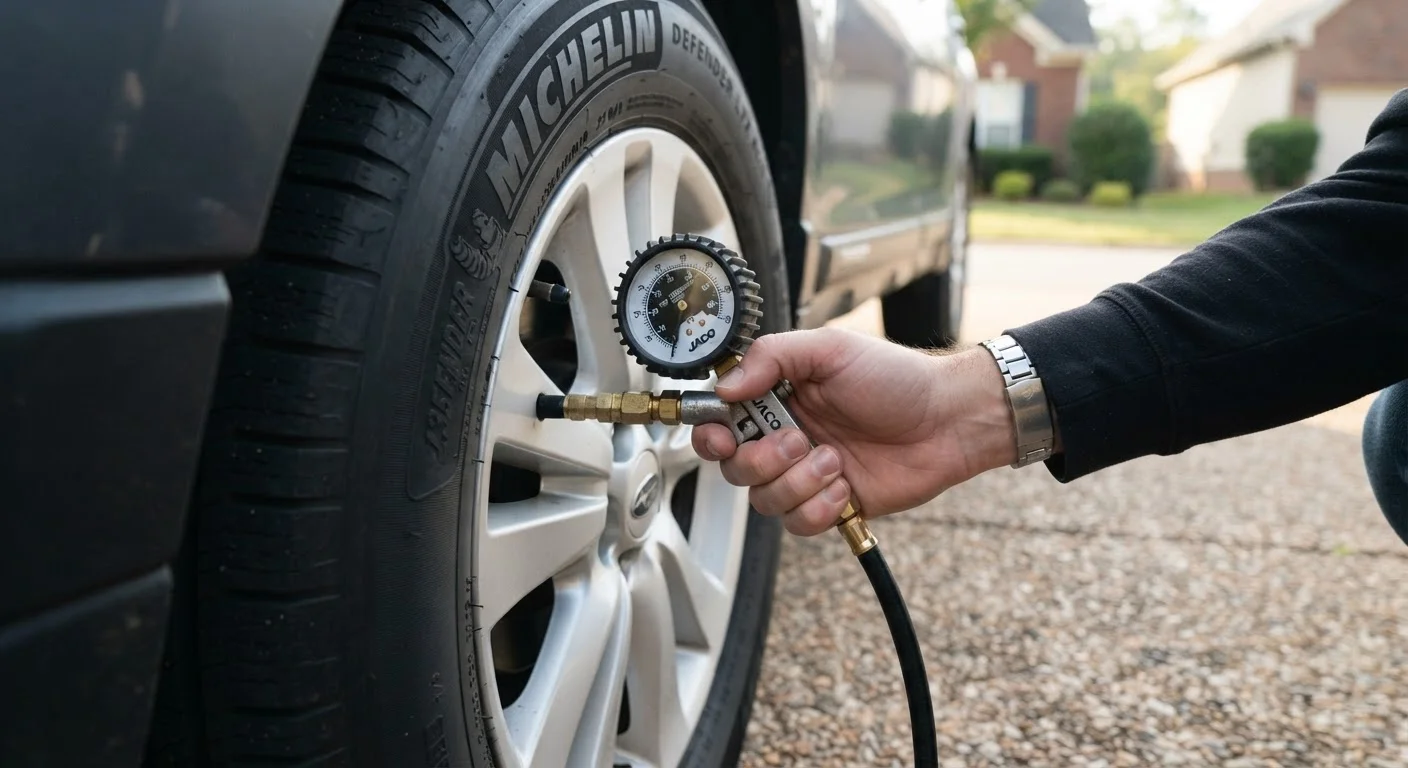
The sidewall maximum is the highest safe pressure for the tire itself, not the vehicle's optimal operating pressure. The correct figure is on the door jamb sticker.
Underinflated tires do increase rolling resistance and hurt fuel economy, so the instinct to run higher pressure has some logic behind it. However, the maximum pressure on the tire sidewall is a structural limit, not a performance target. Running at that pressure hardens the contact patch, reduces grip, causes the center of the tread to wear faster, and can make the ride harsh enough to affect driver fatigue. The vehicle manufacturer's recommended pressure, found on the sticker inside the driver's door or in the owner's manual, is calibrated for the actual wheel and suspension geometry of that car. That is the number to use.
Myth
Idling for several minutes before driving warms the engine and improves fuel efficiency.
Fact
Modern engines warm up faster under light driving load than at idle, and extended idling burns fuel with no distance gained.
Extended warm-up idling made more sense with carbureted engines that needed time to reach stable operating temperatures before accepting load. Electronic fuel injection changed that. Today's engine management systems adjust fuel mixture and timing in real time as the engine warms, and the engine reaches operating temperature faster when it is under gentle driving load than when it sits stationary. Idling for five minutes before a cold-weather commute can consume a meaningful fraction of a gallon while covering zero miles. A brief 30-second idle to allow oil pressure to build, then gentle driving, is sufficient for most modern vehicles. Your owner's manual is the reliable reference for your specific engine.
What actually moves the needle
The interventions with the clearest evidence behind them are also the least exciting: maintaining correct tire pressure, replacing a clogged air filter, and driving with steady throttle inputs rather than sharp acceleration and late braking. The U.S. Department of Energy has published estimates suggesting aggressive driving can lower highway fuel economy by 15 to 30 percent compared with smooth, anticipatory driving.
None of that requires a product purchase. It requires consistent habit. Smooth acceleration reduces fuel use by keeping the engine in a lower load range longer. Routine checks on tire pressure and filters are covered in detail in small checks that protect your fuel budget.
15-30%
Fuel economy lost to aggressive driving
The U.S. Department of Energy estimates aggressive driving can reduce highway fuel economy by 15 to 30 percent compared with smooth, consistent driving.
0.5-3%
Efficiency gain from correct tire pressure
The U.S. Department of Energy notes that keeping tires properly inflated can improve gas mileage by roughly 0.5 to 3 percent depending on conditions.
If your commute is long and repetitive, the compounding effect of consistent driving habits is more meaningful than any single product or shortcut. Fuel economy habits for long commutes covers the specific behaviors worth building into your daily routine.
This article is for general informational purposes only and is not a substitute for advice from a qualified mechanic. Fuel economy outcomes vary by vehicle, driving conditions, and maintenance history.