Why storage keeps failing suburban families
Most storage problems in suburban homes are not about square footage. They are about systems that were never designed around how the household actually moves through its day. Backpacks land by the door instead of in a closet because the closet is full of things that belong somewhere else. Garage shelves collapse under holiday bins because the shelving was chosen for cost, not load capacity.
The storage ideas below focus on what genuinely works across different rooms and household patterns. Each entry covers the concept, why it holds up in practice, and what to watch for when applying it. If you are starting from a more chaotic baseline, the room-by-room organization guide is a useful first step before committing to any storage purchases.
Claim vertical wall space in the entryway
The entryway takes more abuse than almost any other spot in a family home. Shoes, bags, sports equipment, and seasonal gear all compete for a few square feet. The fix is usually not a bigger entryway but taller storage: hooks mounted at multiple heights, a narrow bench with shoe cubbies underneath, and a shelf above the coat zone for bags and helmets.
Hooks placed at adult height rarely get used by children. Mounting a second row at child height changes actual behavior quickly. A labeled bin for each family member at the shoe level prevents the pile-up that makes a tidy entryway impossible to maintain.
Two rows of hooks at different heights get used far more consistently than one row set for adults.
Use drawer dividers in the kitchen before adding more cabinets
Kitchen storage problems are rarely a cabinet shortage. More often, drawers and cabinets hold a mix of unrelated items without any internal structure, so finding a single item means moving ten others. Drawer dividers, pull-out trays inside lower cabinets, and stackable shelf inserts reclaim meaningful space without any construction.
The cutlery drawer is the obvious starting point, but the real gains come in junk drawers, baking supply cabinets, and the cabinet under the sink. Dividers that can be repositioned are worth the small extra cost because kitchen routines shift when children age or cooking habits change.
Repositionable dividers adapt as routines change, which static organizers cannot do.
Treat garage shelving as a structural decision, not a convenience purchase
Garage shelving often fails because families buy light-duty units and then load them with heavy seasonal bins, tools, and sports gear. Steel or heavy-gauge wire shelving rated for the actual load is the more cost-effective choice over time, even at a higher upfront price, because it does not bow or collapse under real-world use.
Wall-mounted systems free up the floor, which matters when cars, bikes, and strollers also need to fit. Overhead ceiling storage is useful for items accessed only a few times a year, such as holiday decorations, keeping prime floor-level space for gear used weekly. Anchor all freestanding units to studs to prevent tipping, particularly if young children use the space.
Shelving rated for your actual load is cheaper in the long run than replacing a collapsed unit.
Build a modular system in kids' rooms rather than fixed furniture
Children's storage needs shift quickly. What works for a five-year-old, shallow bins for toys and picture books, is wrong for a ten-year-old who needs desk space and a place for sports equipment. Modular cube shelving that can be reconfigured, stacked, or split between rooms adapts to those changes without replacement.
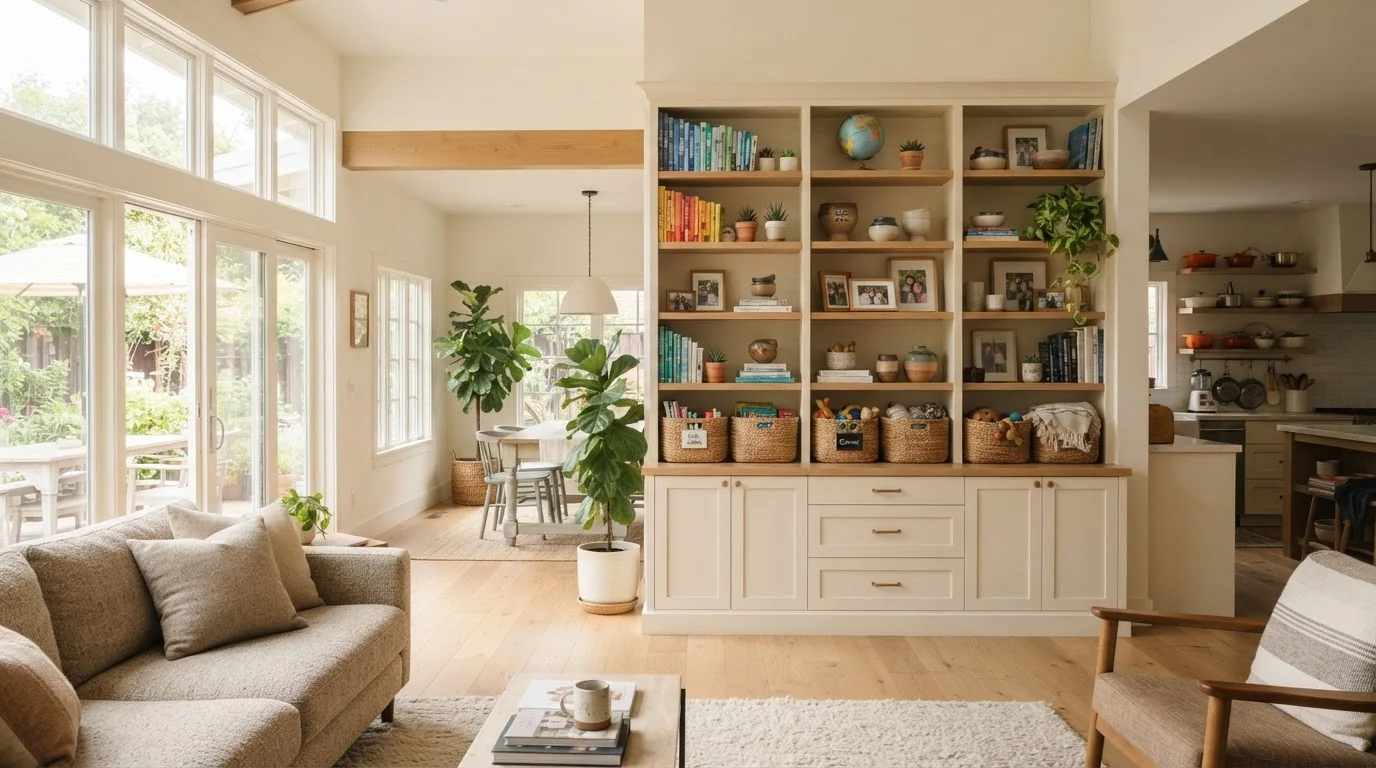
Open cubbies with fabric bins are easier for young children to use independently than drawers, which supports the habit of putting things away without adult prompting. As children get older, the same cubbies can hold folded clothes, school supplies, or hobby materials with minimal adjustment.
Modular cube shelving can be reconfigured as children's needs change, avoiding repeated replacements.
Apply the 'fixed return spot' rule to high-traffic items
Keys, remotes, permission slips, and chargers consume a disproportionate share of daily search time in most households. A fixed, labeled spot for each category eliminates the search without requiring anyone to be naturally organized. The system works because the habit is attached to a physical location, not to memory.
Small wall-mounted trays or a single designated drawer near the main entry door work well. The location needs to be where people naturally empty their pockets or bags, not where it would be tidiest in theory. Getting the placement right matters more than the container itself.
A fixed return spot eliminates daily search time because the habit attaches to a location, not memory.
Use under-bed storage for genuine overflow, not forgotten items
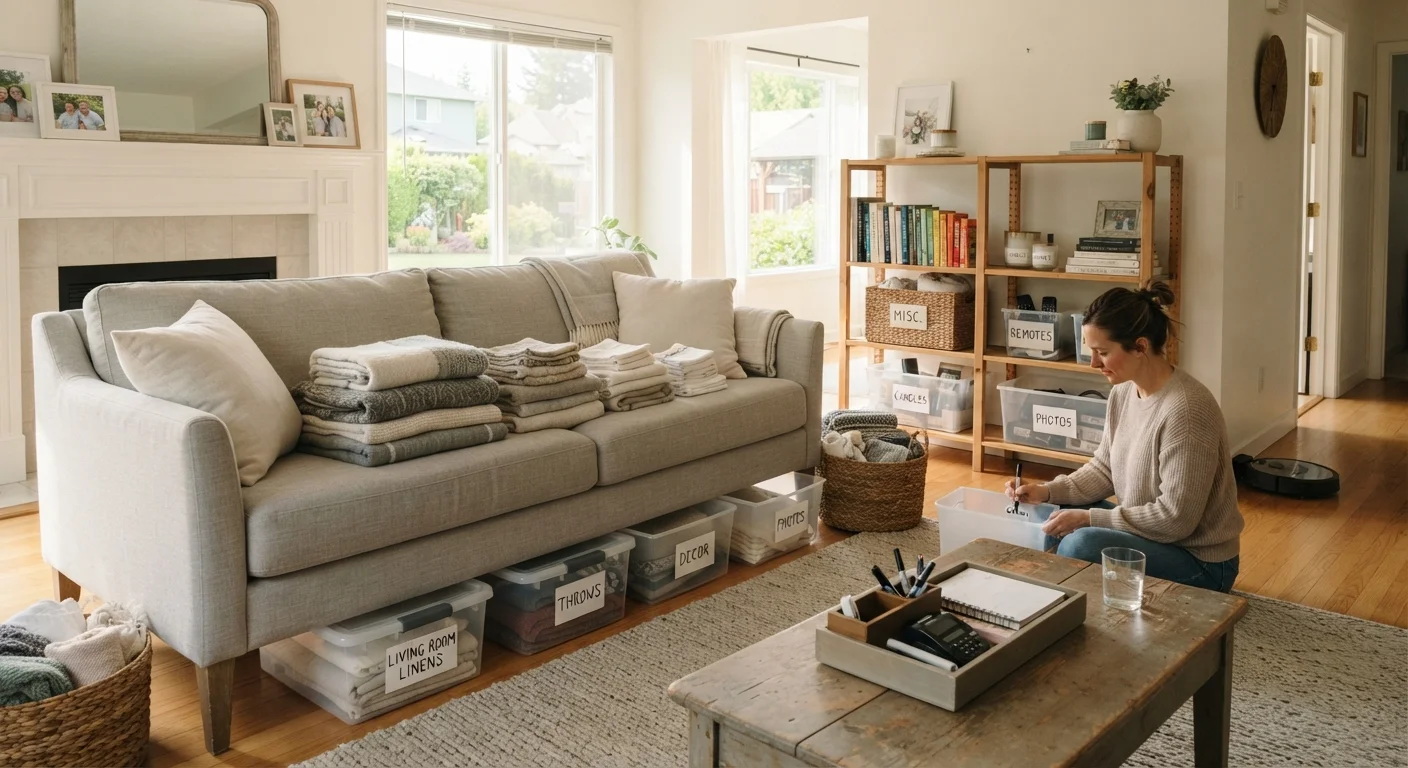
Under-bed space works well for seasonal clothing, extra bedding, and shoes that rotate out with the weather. It fails when it becomes a catch-all for things the household cannot decide about. Flat bins with lids and labels keep the contents visible on inventory and protected from dust.
Beds with built-in drawers are a cost-efficient option in smaller bedrooms where closet space is limited. For standard bed frames, low-profile rolling bins on wheels make access practical rather than theoretical. Limit under-bed storage to items that actually rotate in and out on a predictable schedule.
Under-bed storage works only when contents rotate on a predictable schedule and are clearly labeled.
Consolidate laundry room storage to reduce handling steps
Laundry rooms in suburban homes often hold far more than laundry supplies: cleaning products, bulk paper goods, pet food, and seasonal items all migrate there. Adding shelving above the washer and dryer, along with a sorting system that matches the household's actual laundry routine, cuts the number of times items are touched before they reach their destination.
Wall-mounted folding tables or pull-out surfaces save floor space while providing a dedicated spot for folding, which removes the most common reason clean laundry ends up sitting in a pile. A small rolling cart can hold supplies that need to move between the laundry room and other cleaning zones.
A folding surface in the laundry room is the single change that most reduces the clean-pile problem.
Putting these ideas to work
Storage improvements do not have to happen all at once. Tackling one zone at a time, starting with the area that creates the most daily friction, produces lasting results with less effort than a whole-house overhaul attempted over a single weekend.
Before buying anything, spend a week noting where items consistently pile up and where things are hardest to find. Those two signals will tell you where to spend your time and money first. For families who want to connect storage decisions to broader household budgeting, building a smarter household shopping routine covers how to plan purchases so they stay predictable and cost-controlled. More ideas across the full organization spectrum are collected in the Home Organization hub.
Start with one zone, not the whole house
Organizing everything at once creates short-term chaos and often leads to half-finished systems that are harder to maintain than the original clutter. Choose the one room or zone that causes the most daily frustration, solve it completely, and let that become the template for the next area. Progress by zone is more durable than a weekend-wide overhaul.