
Why tires deserve regular attention
Tires are the only part of your vehicle that touches the road, and every safety system, from brakes to stability control, depends on them having enough grip and proper contact with the pavement. Despite that, tire maintenance is one of the most skipped items in suburban households.
Neglecting tires has real costs. Underinflated tires wear faster and raise fuel consumption. Worn tread extends stopping distances. Misalignment chews through rubber unevenly and forces the engine to work harder. The good news is that most of the monitoring work takes about five minutes per month and requires no mechanical skill. See the broader context in our car maintenance schedule guide.
Checking and maintaining tire pressure
Tire pressure is measured in PSI (pounds per square inch). The correct figure for your vehicle is printed on a sticker inside the driver's door jamb or in the owner's manual. Do not use the maximum PSI molded on the tire sidewall; that is the tire's structural limit, not a target.
Check pressure when tires are cold, meaning the car has been parked for at least three hours or driven fewer than a mile. Driving heats air inside the tire and raises the reading by 4 to 6 PSI, which distorts the measurement.
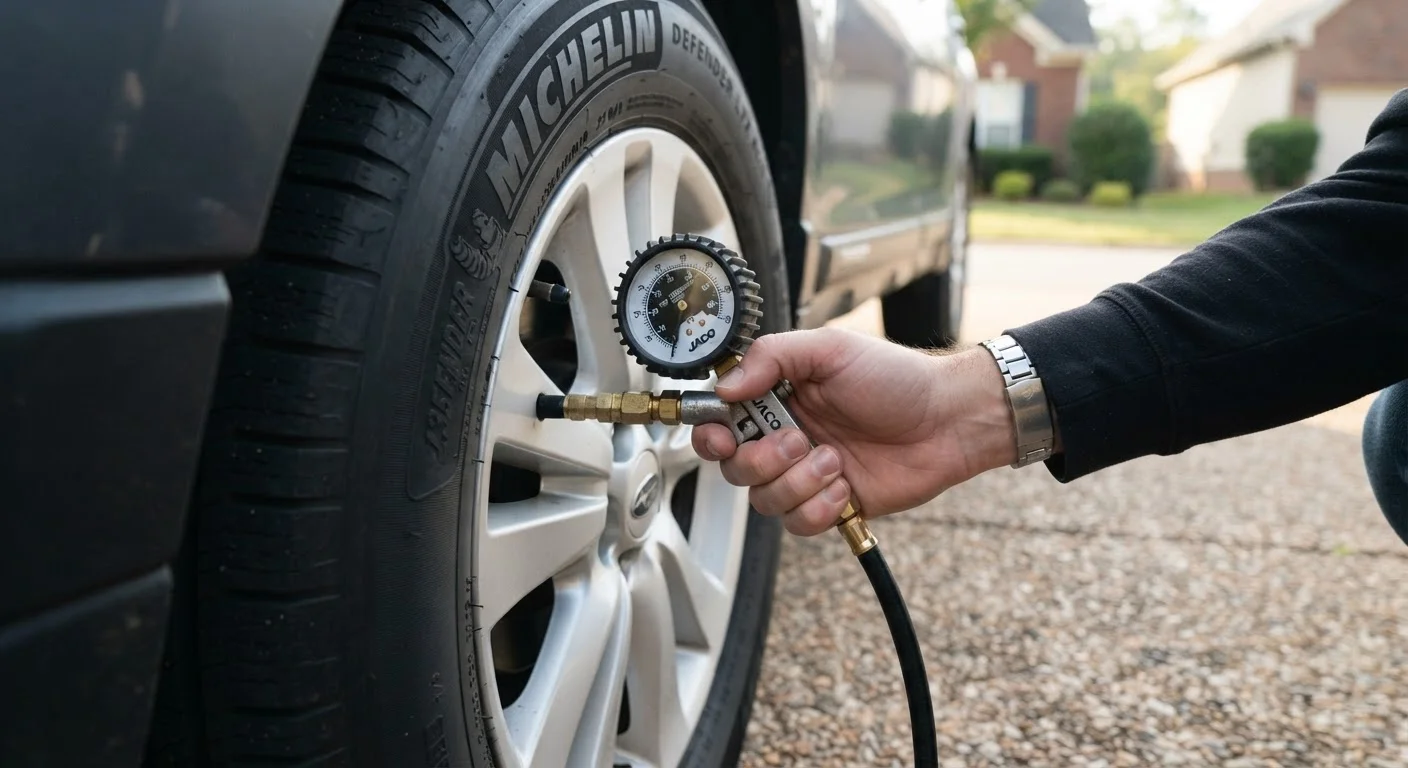
A basic digital gauge costs a few dollars and gives consistent readings. Press the gauge firmly onto the valve stem, read the number, and compare it to the door sticker. Add or release air as needed. Repeat for all four tires and the spare if you carry one.
Check pressure when tires are cold
Always measure tire pressure before driving, or at least three hours after the vehicle has been parked. Warm tires give artificially high readings, which can lead you to let air out unnecessarily. Keep a gauge in the glove box so it is always on hand.
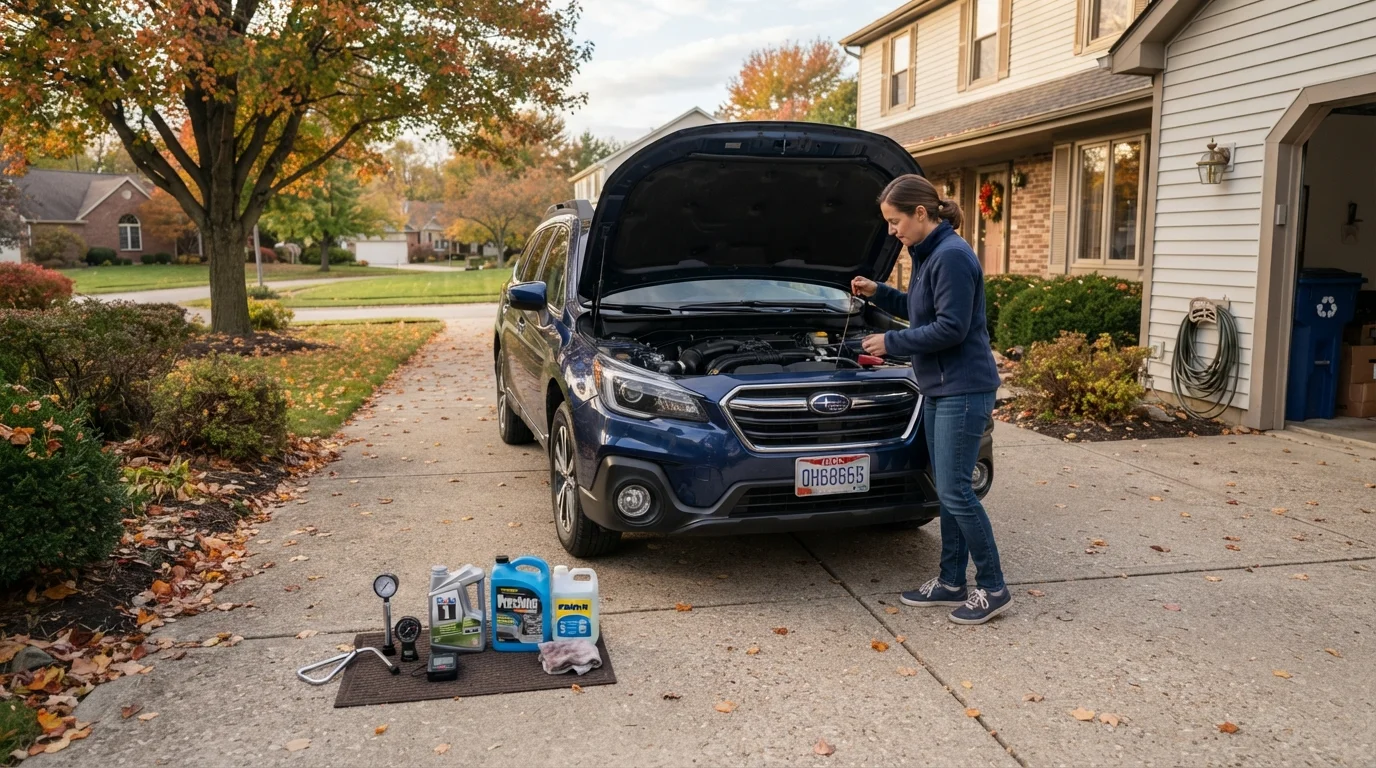
Pressure drops roughly 1 PSI for every 10-degree Fahrenheit drop in outside temperature. In cold-weather months, check more frequently, and plan on topping off tires as fall transitions to winter. Our seasonal car care checklist covers this alongside other cold-weather checks.
For a broader look at how pressure affects your fuel bill, see small checks that protect your fuel budget.
Reading tread depth and wear patterns
Tread depth is measured in 32nds of an inch. New tires typically start at 10/32 to 11/32 inches. Legal minimum in most U.S. states is 2/32, but handling and wet-weather braking degrade well before that point. Many safety organizations recommend replacing tires at 4/32.
Two quick tests work without a gauge. For the penny test, insert a penny into the tread groove with Lincoln's head pointing down. If the top of Lincoln's head is visible, tread is at or below 2/32. For the quarter test, use a quarter the same way; if the top of Washington's head is visible, tread is at or below 4/32, which is a good time to plan replacement.
Wear patterns also tell you what else is wrong. Center wear suggests chronic overinflation. Edge wear on both shoulders points to consistent underinflation. Wear on one edge only usually means alignment is off. Cupping or scalloping across the tread often indicates worn shock absorbers or struts.
Tire rotation: what it does and when to do it
Front and rear tires wear at different rates. On front-wheel-drive vehicles, the front tires carry engine weight and handle steering and acceleration forces simultaneously, so they wear faster. Rotation moves tires to different positions so all four wear at a similar pace, which extends the set's lifespan and keeps handling balanced.
A general interval is every 5,000 to 7,500 miles, though your owner's manual may specify differently. Many drivers pair rotation with every other oil change as a convenient reminder.
When buying a new set of tires, ask the shop to document current tread depth on all four and set a mileage reminder for the first rotation. Having that baseline in writing makes it easier to catch uneven wear at the next service.
Starting with a documented baseline removes guesswork and gives you a concrete comparison point at each subsequent check.
If you regularly carry heavy loads or tow anything, check whether your owner's manual specifies a higher tire pressure for loaded conditions. Many vehicles list a separate loaded PSI on the door sticker.
Running standard pressure under extra weight can cause handling instability and accelerated center-tread wear.
Common rotation patterns depend on whether your vehicle has directional tires (which can only move front-to-rear on the same side) or non-directional tires (which can cross axles). A qualified shop will choose the correct pattern. If your vehicle has a full-size spare that matches the other four, some manufacturers include it in a five-tire rotation, which extends all five tires further.
Wheel alignment explained
Alignment refers to the angles at which your tires contact the road. Three main measurements matter: camber (tilt inward or outward when viewed from the front), toe (whether the front of each tire points inward or outward), and caster (the angle of the steering axis). When these are outside spec, tires scrub against the pavement at the wrong angle and wear unevenly.
Misalignment has several common causes: hitting a large pothole or curb, a minor collision, worn suspension components, or simply accumulated miles on rough roads. Symptoms include the vehicle pulling to one side, a steering wheel that is off-center when driving straight, or rapid uneven tread wear.
Alignment is measured with specialized equipment and corrected by a qualified technician. It is not a DIY task. Have alignment checked whenever you notice pulling or uneven wear, after any significant impact, and at minimum once a year. Some shops include an alignment check with routine service; ask when scheduling.
This article provides general vehicle maintenance information. For repairs involving suspension or steering systems, consult a licensed mechanic before proceeding.
Putting it all together as a maintenance habit
These four tasks work together. Correct pressure reduces the chance of uneven wear that obscures alignment problems. Rotation catches wear patterns early before they become safety issues. Alignment keeps rotation doing its job by ensuring tires contact the road evenly after they are moved.
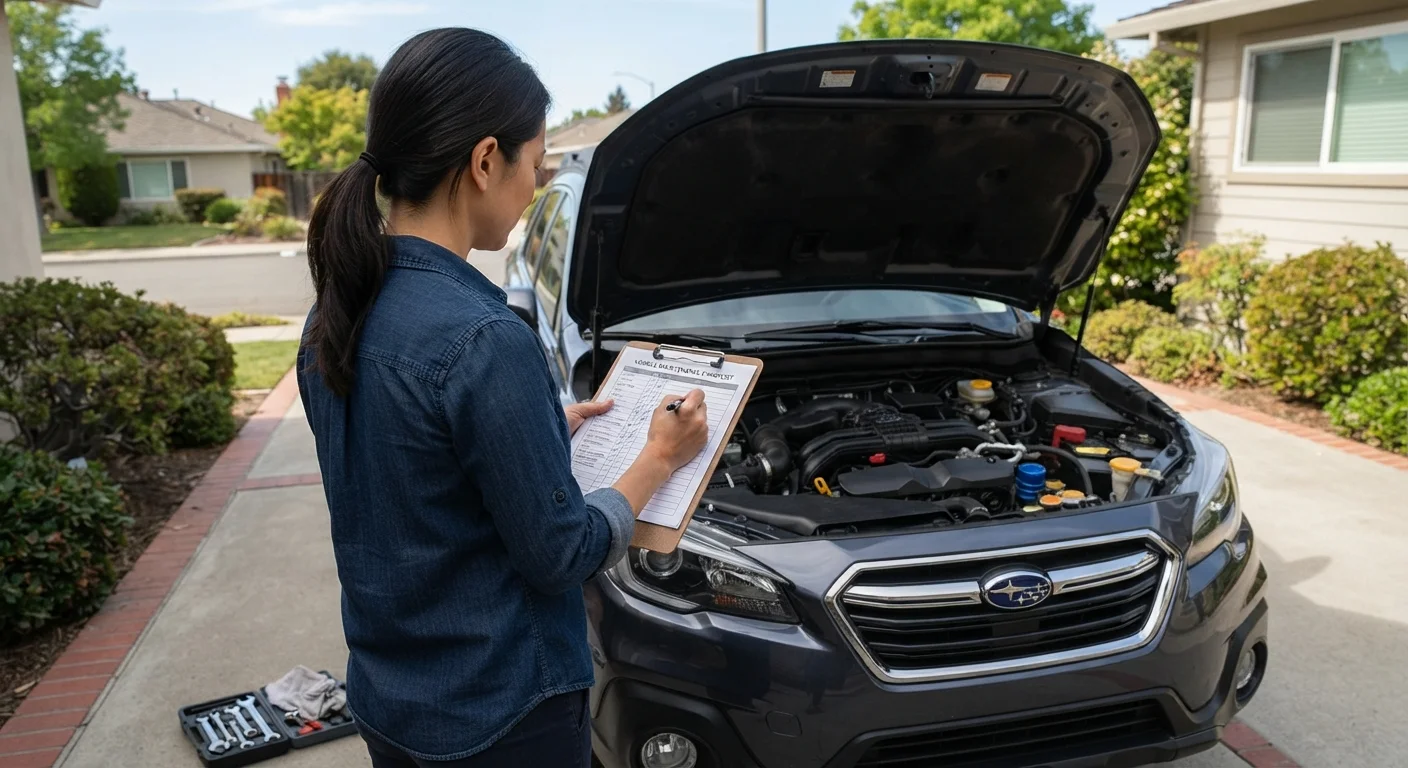
A simple schedule: check pressure monthly (add a calendar reminder), inspect tread visually every time you fill up, rotate on a mileage interval that matches your owner's manual, and book an alignment check annually or after any hard impact. That four-part rhythm covers the full lifecycle of a set of tires.
Tying tire maintenance into your broader vehicle schedule keeps things from slipping. The maintenance schedule decoder can help you build a single calendar that covers tires alongside oil, filters, and fluids.