Why sleep safety gets complicated in pet-owning households
Most parents know the core safe sleep guidelines: place babies on their back, on a firm flat surface, in a bare crib free of soft bedding. What those guidelines do not always spell out is how to apply them when a curious cat or a devoted dog is also living in the home. That gap leaves room for well-meaning but risky assumptions to take hold.
Pet ownership is common in households with young children, and the emotional bond families feel with their animals is real. That bond can make it tempting to dismiss safety concerns as overcaution or to assume that a gentle, familiar pet poses no meaningful risk. The evidence does not support that assumption, and the consequences of getting it wrong are severe. The sections below address the misconceptions parents most commonly hold, and what current guidance actually says.
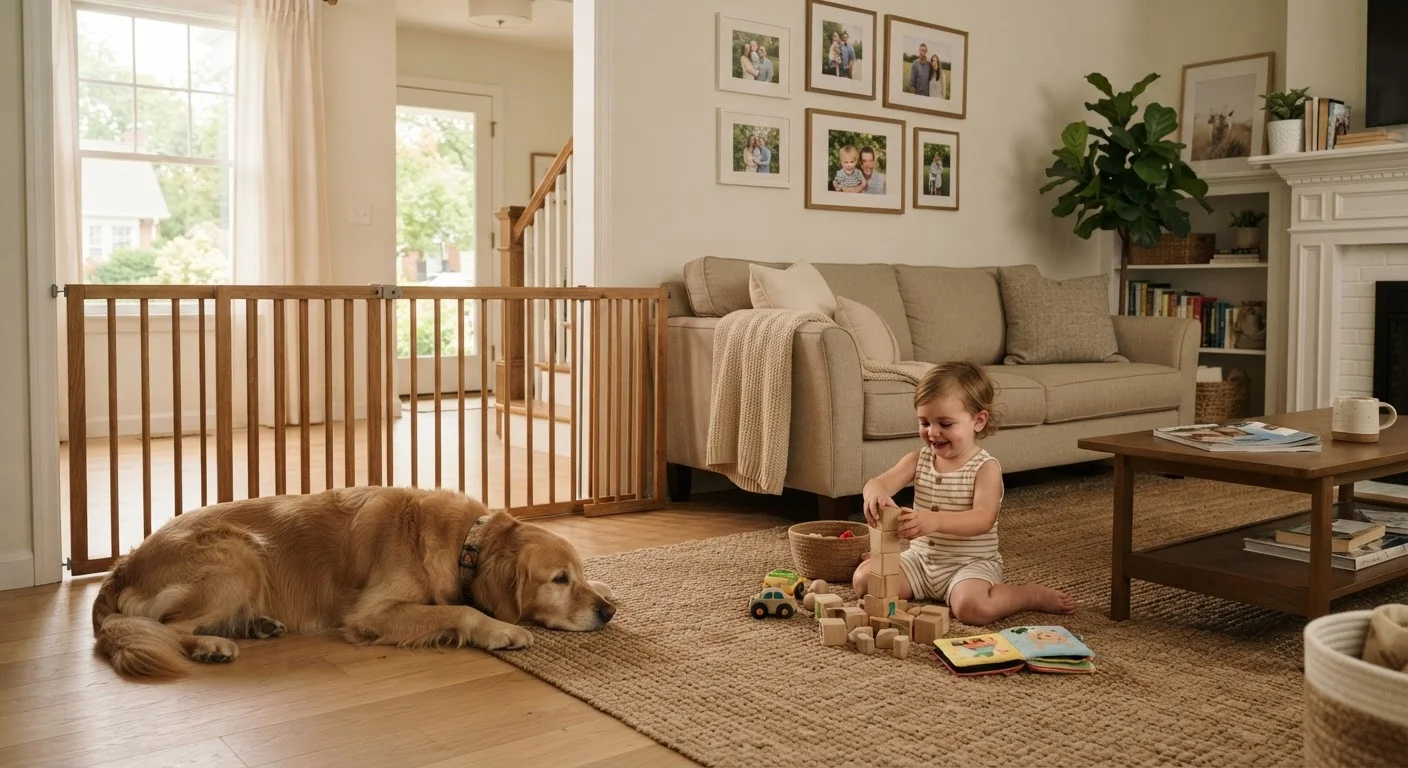
For a broader look at managing shared spaces safely, see the guide to creating safe zones for pets and small children.
Common myths and what the evidence actually shows
The myths below appear repeatedly in parenting forums, well-intentioned family advice, and even some older pediatric literature. Each one has a grain of plausibility, which is exactly what makes it worth examining carefully.
Myth
A well-behaved, gentle pet is safe to leave near a sleeping baby unsupervised.
Fact
Animal behavior around infants is unpredictable regardless of temperament, and no pet should have unsupervised access to a sleeping baby.
A dog or cat that has never shown aggression can still react unexpectedly to an infant's sudden cry, smell, or movement. Even without intent to harm, a large dog lying against a sleeping infant or a cat settling on a baby's chest creates a suffocation risk. The American Academy of Pediatrics recommends that infants sleep in a room with a caregiver but on a separate sleep surface, and that sleep areas be inaccessible to pets. Temperament is not a reliable safeguard against accidental harm.
Myth
Pets in the home will cause the baby to develop allergies or asthma.
Fact
Early exposure to pet allergens may actually reduce the likelihood of some allergic conditions in certain children, though outcomes vary by individual risk factors.
Research published in journals including the Journal of Allergy and Clinical Immunology has found that early-life exposure to cats and dogs is associated with a reduced risk of sensitization to those allergens in some populations. The relationship between pet exposure and allergy development is complex and depends on genetics, the type of animal, and the timing of exposure. Parents with a family history of severe allergies or asthma should discuss the specific situation with a pediatrician or allergist rather than assuming either that pets are definitely harmful or definitely protective.
Myth
Cats are attracted to babies' breath and will suffocate an infant intentionally.
Fact
This is a long-standing folk belief with no scientific basis. Cats are drawn to warmth and confined spaces, but there is no evidence of intentional suffocation.
The idea that cats seek out infant breath dates back centuries and has no support in animal behavioral science. What is true is that a cat seeking warmth may curl up close to or on top of a baby, which creates a genuine physical risk regardless of intent. The appropriate response is to prevent cat access to sleep areas with physical barriers, not to attribute malicious motivation to the animal. The risk is real; the folklore explanation is not.
Myth
If the pet grew up with older children in the home, it will automatically accept the new baby.
Fact
Prior positive experience with older children does not predict how an animal will respond to an infant, whose sounds, smells, and movements are distinctly different.
Infants produce high-pitched cries, unpredictable limb movements, and unfamiliar scents that many animals have never encountered before. A dog comfortable around school-age children may show stress signals, such as panting, yawning, or avoidance, around a newborn. These signals can escalate if the animal feels cornered or unable to retreat. Gradual, controlled introductions and clear exit routes for the pet are important even in households where the animal has a long, positive history with children.
Myth
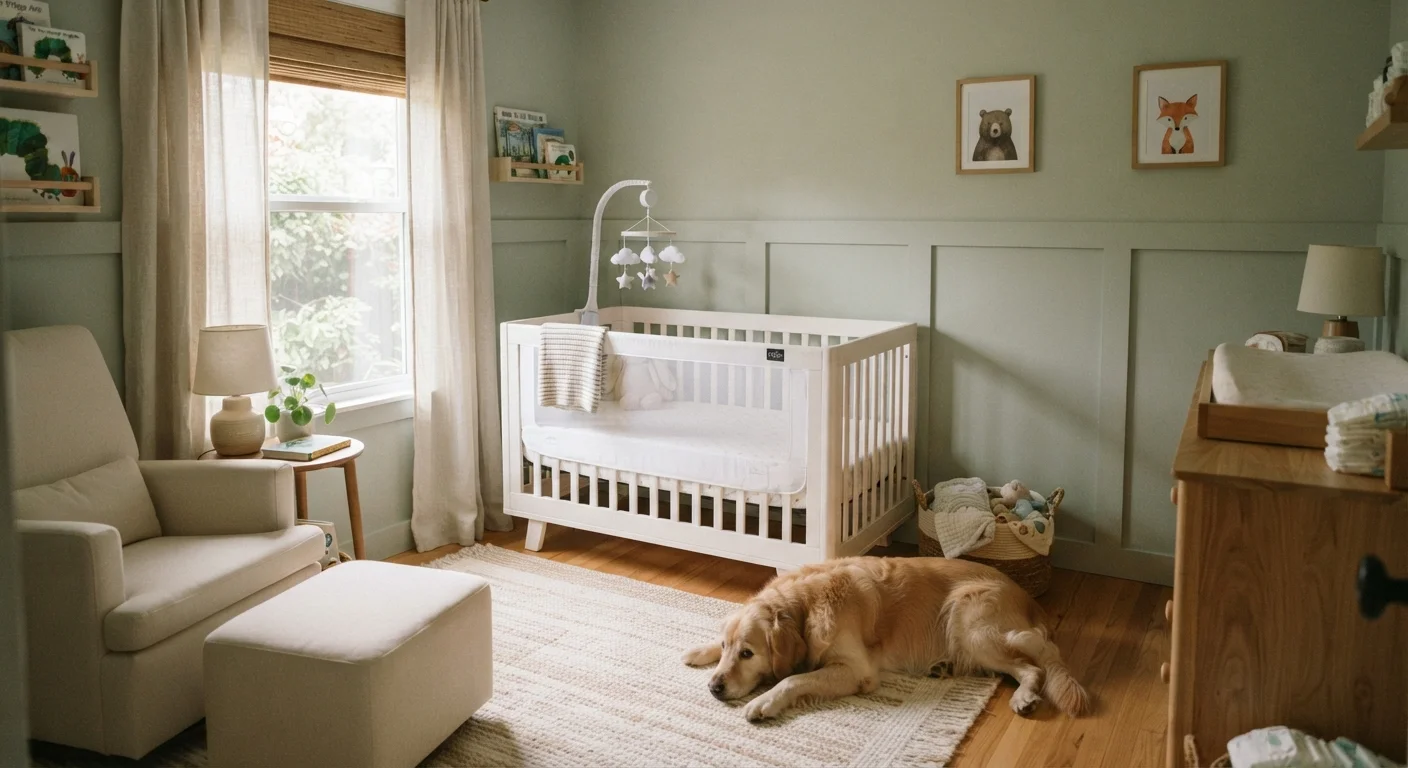
Keeping the pet out of the nursery is enough to protect the baby during sleep.
Fact
Physical separation helps, but protection requires reliable barriers since many pets can open unlatched doors or jump into elevated sleep surfaces.
A standard interior door handle is not a barrier for a motivated dog, and most cats can jump into a crib or bassinet with ease. Effective protection means a door with a secure latch the animal cannot manipulate, combined with a crib or bassinet that has no accessible entry point. Relying on the pet to stay out based on training alone introduces a margin of error that is unacceptable when infant sleep safety is at stake.
Practical steps to protect the sleep environment
Understanding the myths is only useful if it leads to concrete changes at home. The following measures are consistent with guidance from pediatric safety organizations and veterinary behaviorists.
- Install a sturdy latch or hook-and-eye lock on the nursery door, not just a standard handle, because many pets learn to push or paw doors open.
- Use a crib with a firm, well-fitted mattress and no gap larger than two finger-widths between the mattress and the crib sides. A pet cannot enter a properly enclosed crib, but positioning the crib away from surfaces a cat could use as a launch point adds another layer of protection.
- If a baby sleeps in a portable bassinet or play yard, confirm the mesh sides have no tears and the floor of the unit is rigid. Avoid placing soft pet bedding or loose fabric anywhere near the sleep area.
- Establish a consistent routine so the pet learns the nursery is off-limits before the baby arrives, not after. Gradual boundary training is far less stressful for the animal than abrupt exclusion.
The room-by-room pet-proofing guide covers additional hazard checks across the whole house, which is worth reviewing alongside nursery-specific preparations.
When to involve your pediatrician or veterinarian
Parents sometimes hesitate to raise pet-related questions with their child's doctor, assuming it falls outside medical territory. It does not. A pediatrician can help assess whether a specific infant has risk factors that warrant extra precautions, and can refer families to an allergist if respiratory symptoms develop.
A veterinarian or a certified applied animal behaviorist is the right resource for questions about an individual animal's behavior around the baby. Breed generalizations and temperament tests done before the baby's arrival are useful starting points, but they are not substitutes for professional behavioral assessment if an animal shows signs of stress, anxiety, or resource guarding once the infant is home.
Families navigating these dynamics as children grow will find practical context in the guide to teaching kids to interact safely with the family pet. For a broader look at claims about pets and child development, the evidence-based overview of pets and child development addresses many of the same issues from a developmental perspective.