Why the drawer keeps filling up
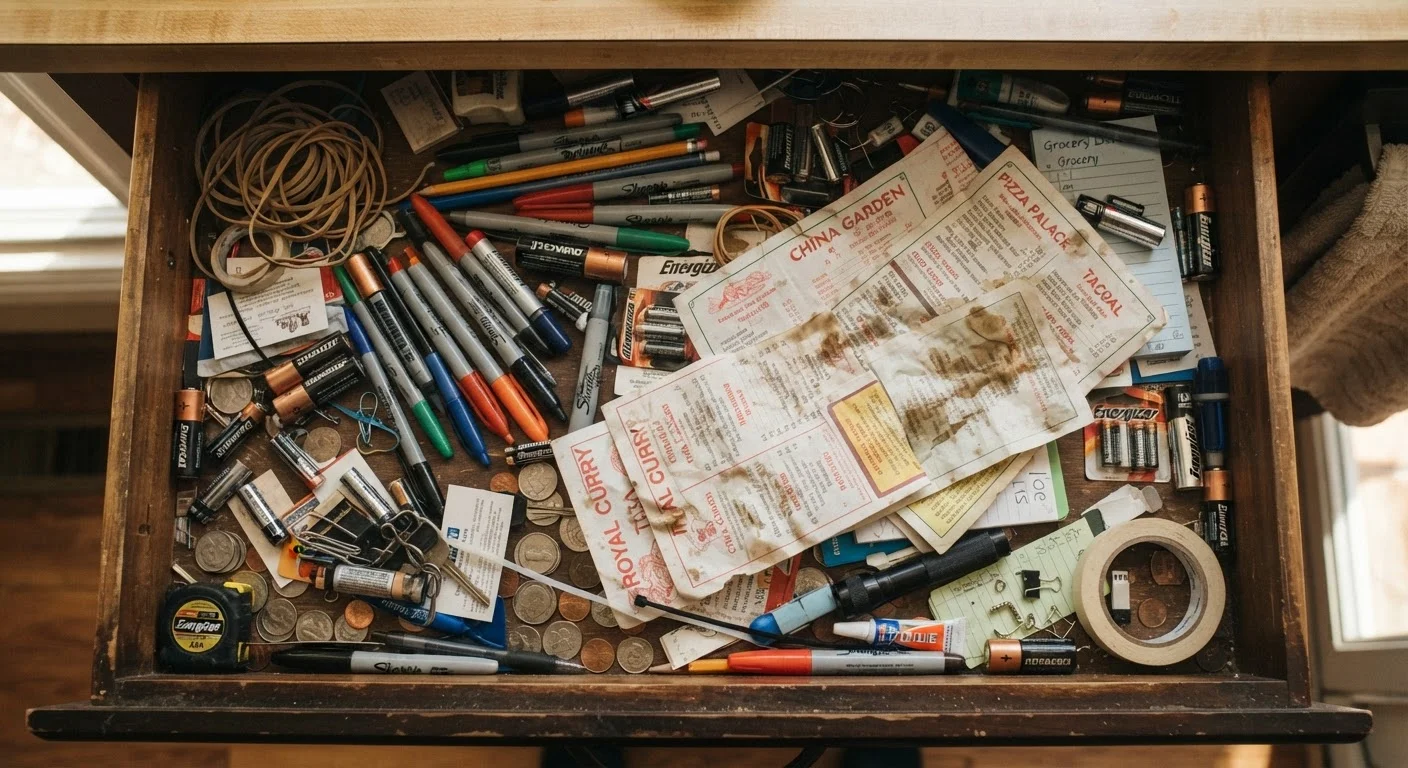
The junk drawer is not a storage failure; it is a symptom. Every item that lands in it is an item that has no other designated place in the home. When a battery, a takeout menu, or a mystery key arrives and there is nowhere obvious to put it, the drawer absorbs it. Do that a dozen times a week and the drawer is full within a month, regardless of how thoroughly it was emptied before.
The cycle persists because most households address the symptom (the full drawer) rather than the cause (the absence of homes for small items). A single decluttering session produces a clean drawer for a few weeks. Then the same items start reappearing, along with new ones, because the underlying flow of incoming objects has not changed.
Understanding why the drawer behaves this way makes the fixes more obvious. The mistakes below are the ones that keep the cycle running.
Purging the drawer without asking why each item ended up there.
Why it happens: Decluttering feels productive, so most people focus on removing items rather than tracing where they came from and why they had no better destination.
Treating the drawer as the default landing spot for anything small or unrecognized.
Why it happens: It is faster to toss an item into the drawer than to decide what to do with it, so the drawer becomes a decision-deferral zone for the whole household.
Using a drawer with no internal divisions or containers.
Why it happens: An open drawer with no structure accepts anything of any size, which makes it easy to overfill and hard to find anything quickly.
Keeping items in the drawer that belong somewhere else entirely.
Why it happens: Items that belong in a garage, office, or medicine cabinet often migrate to the junk drawer and stay there because returning them requires more effort than leaving them.
Skipping a regular maintenance habit after organizing.
Why it happens: A freshly organized drawer looks finished, so the temptation is to treat it as done rather than as a system that needs occasional upkeep.
Building a system that actually holds
Once the mistakes are addressed, the drawer can be set up in a way that resists clutter by design. The goal is not a perfectly sorted drawer; it is a drawer with defined limits and clear categories so that anyone in the household can use it correctly without thinking hard about it.
Start by identifying which categories of small items genuinely belong near the main living areas: a small number of batteries, a few pens, a tape measure, spare keys. Assign a physical slot or small container to each category. When a container is full, that signals it is time to remove something, not add more space.
Avoid expanding the drawer's capacity
Adding a second drawer or a larger organizer to handle overflow does not solve the problem; it delays it. More capacity absorbs more items, which means a bigger purge later and more time spent managing clutter. Keep the storage footprint fixed and let that constraint force real decisions about what the household actually needs to keep accessible.
Label each section, even if the labels feel obvious. Labels remove the decision-making step for other household members and prevent the drawer from becoming a general deposit point again. A drawer with six labeled compartments and a rule that nothing goes in without a compartment is fundamentally different from an open drawer with no friction.
Pair this with a brief weekly sweep, two minutes at most, to return any items that drifted. This is the same logic that applies to managing other household routines: small consistent actions outperform periodic large efforts. If managing physical clutter feels connected to broader household friction, the approach in a household essentials audit can help surface other areas where items accumulate without a clear system.